Posts

Showing posts with the label Interview

Hive Challenges: Bucketing, Bloom Filters and More

In the second post of this series, we will learn about few more aspects of table design in Hive. Now that you know about partitioning challenges , you will be able to appreciate these features which will help you to further tune your Hive tables. Bucketing In addition to Partitioning the tables, you can enable another layer of bucketing of data based on some attribute value by using the Clustering method. Clustering can be used with partitioned or non-partitioned hive tables. One particular use case where Clustering becomes useful when your partitions might have unequal number of records (e.g. users logging in per country, US partition might be a lot bigger than New Zealand). In such cases, you can define the number of buckets and the clustered by field (like user Id), so that all the buckets have equal records. In partitioning each partition gets a directory while in Clustering, each bucket gets a file. Records with the same bucketed column will always be stored in the same bucke...
Hive Challenges: Partitioning, Performance and More

In this series of articles, I will talk about the challenges while working with Hive tables. Like with any other Apache toolkit, there are a lot of configurations to play around with and you need to know a few of them. Luckily, for partitioning there are a lot of concepts which are similar to the RDBMS world. So, if you have some idea about table partitioning in databases, this should not be very complex for you. Q: How to decide number of partitions for a very large table? There are multiple aspects to look out for, Cardinality:  Find out the cardinality of important attributes to find out how many distinct values the attribute holds. If you are making any attribute as a partition, it should have as few distinct values as possible( though few hundred partitions for a table are also fine). Sorting:  If you can compromise on the write speeds, sort the data while writing. This allows formats like ORC to capture the starting and ending values in the metadata of fi...

Cracking Data Engineering Interviews

Of late, a lot of people have asked me for tips on how to crack Data Engineering interviews at FAANG (Facebook, Amazon, Apple, Netflix, Google) or similar companies. I have not worked at all of these companies so I can't share tips which will necessarily apply for all of them but I will share tips which can be generalized for most of the big companies. First of all, the field of Data Engineering has expanded a lot in the last few years and has become one of the core functions of any big technology company. The obvious reason for this expansion is the amount of data being generated by devices and data-centric economy of the internet age. Each company is focussed on making the best use of data owned by them by making data driven decisions. If you compare this to the Data Engineering roles which used to exist a decade back, you will see a huge change. In the past, Data Engineering was invariably focussed on Databases and SQL. Even now, these two form some part of most Data Engin...

Uber Data Model

Image
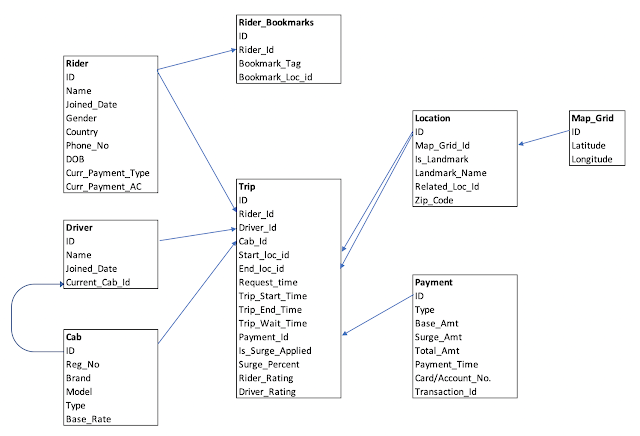
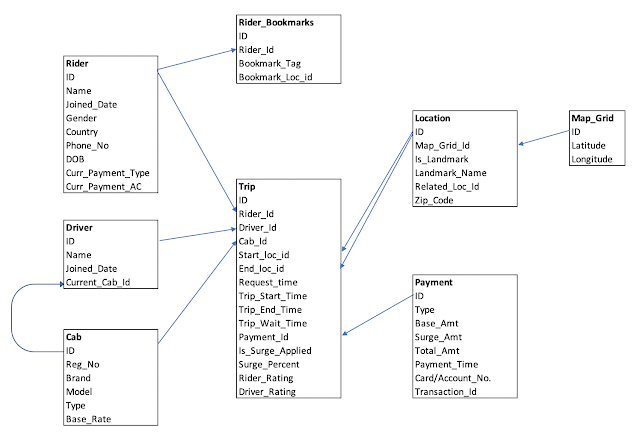
In this post I will try to come up with a data model which can serve the requirements of ride sharing companies like Uber, Lyft, Ola etc. We will approach the problem as an interview and see how we can come up with a feasible data model by answering important questions. Important Entities The first step towards building a data model is to identify important actors/ entities involved in the process. In our case, if we think about our interaction with taxi apps, we can identify important entities involved. The user (i.e. Rider) is one such entity, so is the Driver/ Partner . Once we open the app, we try to book a trip by finding a suitable taxi/ cab from a particular location to another . After the trip gets finished, the app collects the payment and we are done . Ideally, the flow continues to reviews/ ratings, helpcenter in case of issues etc. but for this post we will only consider scenarios till the ride gets finished. So, to summarize, we have the following key entities...

Data Engineer Interview Questions: SQL

Image
In this post, I will try to share some actual questions asked by top companies for Data Engineer positions. A lot of these companies will cover data modelling as one of the rounds and will use the data model for the next round based on SQL queries. Q1: Find the number of drivers available for rides in any area at any given point of time. Q2: Do you consider Driver and Rider as separate entities? Why or why not? Q3: Give me all passenger names who used the app for only airport rides. Q4: How will you decide where to apply surge pricing? Q5: How will you calculate wait times for rides? Q6: A driver can ride multiple cars, how will you find out who is driving which car at any moment? Q7: Find out Rank without using any function. Q8: How will you delete duplicates from a table? Q9: How will you find percentile? Q10:  You have 3 tables, user_dim (user_id, account_id), account_dim (account_id, paying_customer), and dload_facts (date, user_id, and downloads), fin...

UBER Data Architecture

Image
In this post, I will try to cover the data architecture Uber has built to support their big data applications. This should be applicable for other ride hailing apps as well. There are multiple modules at play here so I will try to give a brief overview along with a detailed discussion on the data architecture.  An aeroplane view of the problem tells us that effectively we are trying to solve a demand vs. supply problem. All the Drivers active at any point of time constitute the supply while all the cab requesters (Riders) form the demand. What Uber tries to do is to have the best matching between demand and supply "at any point at any moment". I have highlighted the location and temporal conditions as they are critical for the success of what Uber tries to do. Let's get started to see how Uber comes around these challenges by creating a scalable data architecture. Every Driver active on Uber keeps sending his location data to the server (e.g. every 5 seconds). T...