Posts

Showing posts with the label SQL

Redshift to Snowflake Migration: SQL Function Mapping

Gather around, kids! We have a new hero in town - Snowflake . Snowflake is killing other databases like Thanos killed spoiler alert  in Avengers . They started with Teradata and Vertica, and are now aiming their guns at AWS Redshift. And they have earned this right. They have really addressed the pain points people are facing while using these other databases. For example, scaling up and down in Redshift is a painful process. On the other hand, in Snowflake you can spin up clusters on the fly without much hassle or effort with almost zero impact on running pipelines.  While this post is not about finding the better one among Snowflake and Redshift, you should still read it if you are one of those thinking about making the move from Redshift to Snowflake. This post lists out the most common functions used in Redshift and points out their Snowflake counterpart. This list is not exhaustive by any means and I will strive to keep on updating it as and when I find new ones. ...
Cracking Data Engineering Interviews

Of late, a lot of people have asked me for tips on how to crack Data Engineering interviews at FAANG (Facebook, Amazon, Apple, Netflix, Google) or similar companies. I have not worked at all of these companies so I can't share tips which will necessarily apply for all of them but I will share tips which can be generalized for most of the big companies. First of all, the field of Data Engineering has expanded a lot in the last few years and has become one of the core functions of any big technology company. The obvious reason for this expansion is the amount of data being generated by devices and data-centric economy of the internet age. Each company is focussed on making the best use of data owned by them by making data driven decisions. If you compare this to the Data Engineering roles which used to exist a decade back, you will see a huge change. In the past, Data Engineering was invariably focussed on Databases and SQL. Even now, these two form some part of most Data Engin...

Uber Data Model

Image
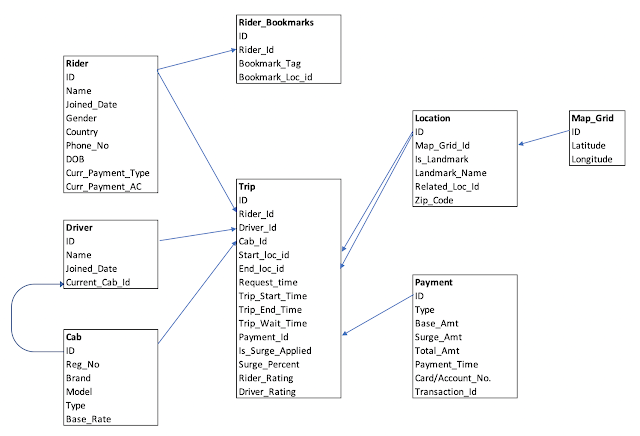
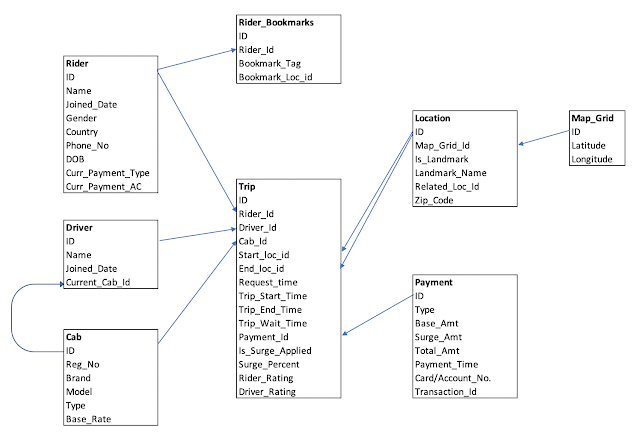
In this post I will try to come up with a data model which can serve the requirements of ride sharing companies like Uber, Lyft, Ola etc. We will approach the problem as an interview and see how we can come up with a feasible data model by answering important questions. Important Entities The first step towards building a data model is to identify important actors/ entities involved in the process. In our case, if we think about our interaction with taxi apps, we can identify important entities involved. The user (i.e. Rider) is one such entity, so is the Driver/ Partner . Once we open the app, we try to book a trip by finding a suitable taxi/ cab from a particular location to another . After the trip gets finished, the app collects the payment and we are done . Ideally, the flow continues to reviews/ ratings, helpcenter in case of issues etc. but for this post we will only consider scenarios till the ride gets finished. So, to summarize, we have the following key entities...

Data Engineer Interview Questions: SQL

Image
In this post, I will try to share some actual questions asked by top companies for Data Engineer positions. A lot of these companies will cover data modelling as one of the rounds and will use the data model for the next round based on SQL queries. Q1: Find the number of drivers available for rides in any area at any given point of time. Q2: Do you consider Driver and Rider as separate entities? Why or why not? Q3: Give me all passenger names who used the app for only airport rides. Q4: How will you decide where to apply surge pricing? Q5: How will you calculate wait times for rides? Q6: A driver can ride multiple cars, how will you find out who is driving which car at any moment? Q7: Find out Rank without using any function. Q8: How will you delete duplicates from a table? Q9: How will you find percentile? Q10:  You have 3 tables, user_dim (user_id, account_id), account_dim (account_id, paying_customer), and dload_facts (date, user_id, and downloads), fin...