Posts

Showing posts with the label Facebook

Hive Challenges: Bucketing, Bloom Filters and More

In the second post of this series, we will learn about few more aspects of table design in Hive. Now that you know about partitioning challenges , you will be able to appreciate these features which will help you to further tune your Hive tables. Bucketing In addition to Partitioning the tables, you can enable another layer of bucketing of data based on some attribute value by using the Clustering method. Clustering can be used with partitioned or non-partitioned hive tables. One particular use case where Clustering becomes useful when your partitions might have unequal number of records (e.g. users logging in per country, US partition might be a lot bigger than New Zealand). In such cases, you can define the number of buckets and the clustered by field (like user Id), so that all the buckets have equal records. In partitioning each partition gets a directory while in Clustering, each bucket gets a file. Records with the same bucketed column will always be stored in the same bucke...
Hive Challenges: Partitioning, Performance and More

In this series of articles, I will talk about the challenges while working with Hive tables. Like with any other Apache toolkit, there are a lot of configurations to play around with and you need to know a few of them. Luckily, for partitioning there are a lot of concepts which are similar to the RDBMS world. So, if you have some idea about table partitioning in databases, this should not be very complex for you. Q: How to decide number of partitions for a very large table? There are multiple aspects to look out for, Cardinality:  Find out the cardinality of important attributes to find out how many distinct values the attribute holds. If you are making any attribute as a partition, it should have as few distinct values as possible( though few hundred partitions for a table are also fine). Sorting:  If you can compromise on the write speeds, sort the data while writing. This allows formats like ORC to capture the starting and ending values in the metadata of fi...

Data Engineer Interview Questions: SQL

Image
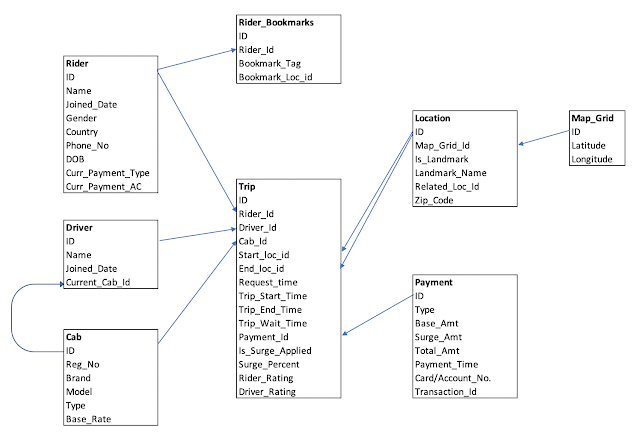
In this post, I will try to share some actual questions asked by top companies for Data Engineer positions. A lot of these companies will cover data modelling as one of the rounds and will use the data model for the next round based on SQL queries. Q1: Find the number of drivers available for rides in any area at any given point of time. Q2: Do you consider Driver and Rider as separate entities? Why or why not? Q3: Give me all passenger names who used the app for only airport rides. Q4: How will you decide where to apply surge pricing? Q5: How will you calculate wait times for rides? Q6: A driver can ride multiple cars, how will you find out who is driving which car at any moment? Q7: Find out Rank without using any function. Q8: How will you delete duplicates from a table? Q9: How will you find percentile? Q10:  You have 3 tables, user_dim (user_id, account_id), account_dim (account_id, paying_customer), and dload_facts (date, user_id, and downloads), fin...